Landscaping

A landscaping CRM has to know the difference between dormant and gone

Every recurring account you have goes quiet at the same time, for months, by design. Then spring arrives and you are working out who is coming back by memory and phone calls. No other trade reassembles its entire customer base once a year, and most software is not built for a customer who is neither active nor lost.

3▲
statuses, and most systems have two
Activeon the route this week
Losttold you they are leaving
Dormantthe one that decides your spring

What is a landscaping CRM?

A landscaping CRM holds your customers, properties and relationship history, and supports the sales, follow-up and reactivation side of the business. Many landscaping platforms also bundle field-service functions such as scheduling, crew routing, quoting and invoicing, but those are a separate capability rather than part of what a CRM is. What a landscaping system has to do that general software does not is carry a recurring customer through a dormant season and bring them back without anyone reconstructing the list from memory.

The Third Status

Active and lost are not enough categories for this trade

A two-status model, active or lost, describes most businesses adequately because most businesses only have those two. It does not describe landscaping. There is a third state that lasts several months and contains almost everybody: the account that has not canceled, is not being serviced, and may or may not answer the phone when the season turns.

That ambiguity is where the money leaks. A customer who intended to return but never got a call goes to whoever knocks first. A customer who quietly decided to switch is still on your projected route, so the spring schedule is built on accounts that are not coming. Both errors look identical in a system that only knows active and lost.

The fix is unglamorous and it is mostly a decision rather than a feature: record a status that means paused, attach a date to it, and treat that date as something the system raises rather than something somebody remembers.

What To Record

Track the property, not just the customer

A landscaping company visits the same address thirty times a year. That is more contact than any other trade in this library has, and almost none of what the crew learns gets written down.

What to hold on the propertyWhy it earns its place
Gate codes, dogs, where the tap is, which neighbor complainsEvery crew that visits learns this and most of it lives in one person's head. The day that person leaves, the route gets harder for everyone.
What is planted and when it went inTurns a mowing account into a company that can quote the replanting, the irrigation fault and the bed redesign, because you know what is there.
Enhancement work mentioned and not bookedA customer who said they were thinking about a patio in May is the warmest install lead you will get all year, and it is usually written on nothing.
Season start and end dates, per accountThe only way to know who to call in March and in what order. Without it the spring restart is a phone list assembled from memory.
Which cluster the property belongs toMakes the route visible as a thing you manage rather than something that emerged. New accounts can then be accepted or priced against it.

None of that is sophisticated and none of it needs expensive software. What it needs is the decision that the property has a record, not just the billing contact, and that the crew is expected to add to it.

Four Questions For A Trial

What to test before the feature list convinces you

All four are answerable in a trial week and none of them appear on a comparison chart.

Can an account be paused without being deleted?

Ask it first. If the only options are active and canceled, you will either carry dead accounts into your spring planning or lose the history of customers who were always coming back. Surprisingly few systems handle this properly.

Does the crew record anything, or only the office?

Thirty visits a year is thirty chances to learn something about the property, and all of it is wasted if updating the record means going back to a desk. If it cannot be done on a phone with dirty hands in ninety seconds, it will not happen.

Can you see the route, not just the day?

A schedule that lists tomorrow's jobs is not the same as seeing where they are. Whoever books work needs to know what is already near it, otherwise the clusters you built get diluted one convenient yes at a time.

What happens to a quote nobody accepted?

Install quotes in this trade go quiet for weeks and then convert. A system that drops them into a pile is the reason most landscaping companies cannot tell you their proposal conversion rate.

The Spring Restart

Spring revenue is often decided before spring arrives

Renewal in landscaping is not a renewal notice. It is somebody ringing round before the season starts - February in a cold market, earlier or later elsewhere - and in most companies it is the owner doing it in whatever order occurs to them. The accounts that get called first are the ones they remember, which tends to mean the oldest and the loudest rather than the ones on the tightest part of the route.

A system that holds a paused status with a date turns that into a list: who is due, in which cluster, in what order, and who has not responded. That is the whole difference between reassembling a route and defending one, and it costs nothing beyond deciding to record it.

It is also the moment the enhancement work gets sold. A customer confirming their mowing for another year is already saying yes to something, and the note from last August about the patio they mentioned is sitting right there if anybody wrote it down.

What we see building these

We build and run the follow-up side of this for clients, and the pattern is consistent across trades: the automation that works is small. On one account an inquiry arriving at 6:40 on a weekday evening got a text, an email and a message inside sixteen minutes, with nobody at a desk, and the customer replied at 6:57pm with their specification. Nothing clever happened. A date triggered a sequence.
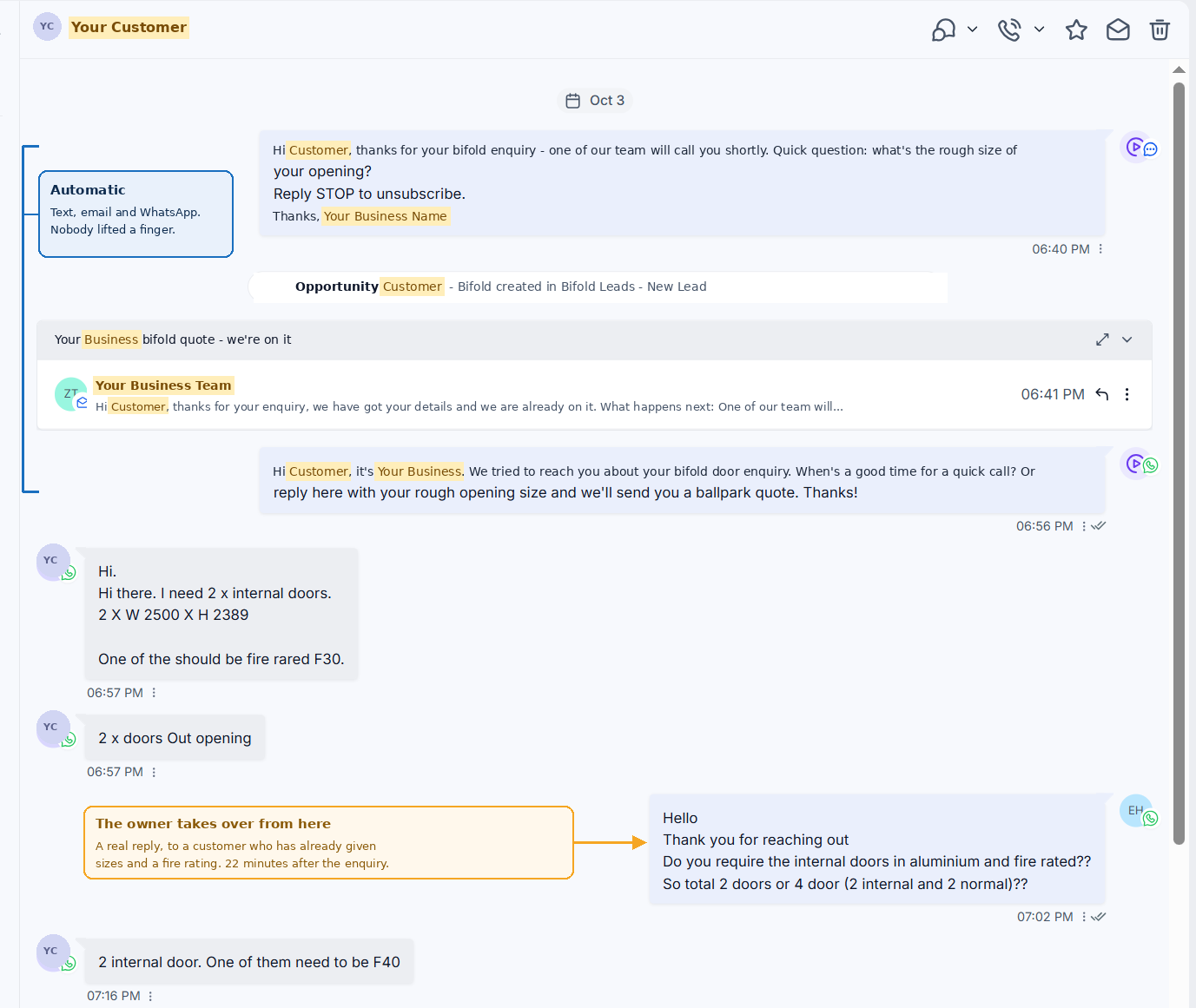
CRM conversation thread showing an automated text, email and WhatsApp sequence sent to a new inquiry, with the customer reply and the owner taking overOpen full size
Text out at 6:40pm, email at 6:41pm, WhatsApp at 6:56pm. The customer replied at 6:57pm and the owner picked it up at 7:02pm. Customer and business names are replaced with placeholders, shown highlighted. Timestamps, message content and system actions are unaltered.

That was a home improvement contractor rather than a landscaping company, and it was a new inquiry rather than a dormant account, so treat it as the mechanism rather than a result to expect. The relevant part is that the same mechanism is what a paused account needs: a date, and something that fires on it without anyone remembering. The full breakdown is published, caveats included.

FAQ

What landscapers ask

What is the best CRM for a landscaping business?

▾
We do not sell this software and have not run these products in production, so there is no ranked list here. Worth knowing about the ones you will find: most comparison pages are published by a vendor being compared or by an affiliate, and the ordering usually reflects that. Search this term and the top result is a Reddit thread, which tells you how much operators trust those pages.

Do we need landscaping-specific software or will a general CRM do?

▾
If you run crews and a route, trade software earns its price, because scheduling recurring visits by geography is the thing general CRMs are worst at. If you are mostly doing project work with a handful of jobs running at once, a general CRM or a well-kept spreadsheet can genuinely be enough. The deciding factor is how many recurring visits move around in a week.

How do we handle customers who pause over winter?

▾
Decide what paused means in your system before the season ends, not after. Give it a status, attach the expected restart date, and make that date something the system surfaces. Deleting them loses the history; leaving them active makes your spring projections fiction.

What should the crew be recording on site?

▾
Less than you want and more than they do now. Three or four things per visit that genuinely change a future decision: anything that affects access, anything the customer mentioned wanting, and anything that will need work before next season. If the list is longer than that it will be ignored.

How much does landscaping CRM software cost?

▾
Usually per user per month, which is worth modeling honestly before committing. Count the office as well as the crews, and ask what happens when you add seasonal staff in April and lose them in October. A per-seat price that is comfortable in winter can be uncomfortable at peak.

When is the right time to switch systems?

▾
In the off-season, and earlier than feels necessary. The slow part is never the data import, it is agreeing how accounts and services get categorized and getting crews to follow it. Before you start, confirm you can export everything again, including property notes and photographs.

How much of your spring is guesswork?

The Growth Score checks all five engines against your business and estimates what each gap is worth per month, including what happens to a customer between the last cut of one season and the first of the next. Free, and yours whether we work together or not.

Get My Complimentary Growth Score →
Keep reading

More for Landscapers

About the author

Rafi builds customer acquisition systems for home service businesses, focused on local SEO, Google Business Profiles, websites, lead capture and automated follow-up. Around seven years doing this work for local companies. Founder of LeadsFortress, a product of Web Premium Services, a US-registered company.

About Rafi → · Get in touch · Last reviewed November 2026